- Home
- GOVERNMENT
- Departments
- Environmental Services
- Stormwater Pollution
Stormwater Pollution Prevention
The mission of the Stormwater Management Program is to maintain and promote the quality of water and environmental resources for the citizens of Fountain Valley and to ensure compliance with water quality regulations.
The Stormwater Management section of the City of Fountain Valley Public Works Department is responsible for overall management of stormwater quality issues in the City of Fountain Valley. Through public education and outreach, the Stormwater Management section ensures that all residents, businesses, and municipal departments are familiar with federal, state and local laws and regulations pertaining to stormwater quality issues, contact Public Works Department at 714-593-4433.
Did you know it's the law? If you live in Southern Orange County, runoff from landscape irrigation that enters streets and catch basins is prohibited.
Orange County's Stormwater Program
H2OC Stormwater Program: Orange County's Solution to Runoff Pollution
COMMERCIAL AND INDUSTRIAL
All commercial and industrial businesses operating within the city of Fountain Valley must implement pollution control measures. Every day, business operations have the ability to come in contact with stormwater, such as material handling and storage. It is the responsibility of the business owner and employees to ensure that their activities are not negatively impacting the environment.
The city of Fountain Valley inspects commercial and industrial facilities and provides stormwater best management practices (BMP) education and enforcement, if necessary. All businesses operating within the city of Fountain Valley must comply with Fountain Valley Title 14 chapter 14.40, Stormwater Management and Discard Control.
BMP FACTS SHEETS
IC2 - Animal Handling Areas
IC3 - Building Maintenance
IC4 - Carpet Cleaning
IC5 - Concrete and Asphalt Production
IC6 - Contaminated or Erodible Surface Areas
IC7 - Landscape Maintenance
IC8 - Nurseries and Greenhouses
IC9 - Outdoor Drainage from Indoor Areas
IC10 - Outdoor Loading and Unloading of Materials
IC11 - Outdoor Process Equipment Operations and Maintenance
IC12 - Outdoor Storage of Raw Materials
IC13 - Overwater Activities
IC14 - Painting, Fishing, and Coatings of Vehicles, Boats, Buildings and Equipment
IC15 - Parking and Storage Area Maintenance
IC16 - Pool and Fountain Cleaning
IC17 - Spill Prevention and Clean Up
IC18 - Vehicle and Equipment Fueling
IC19 - Vehicle and Equipment Maintenance and Repair
IC20 - Vehicle and Equipment Washing
IC21 - Waste Handling and Disposal
IC22 -Eating and Drinking Establishments
IC23 - Fire Sprinkler Testing/Maintenance
IC24 - Disposal of Waterwaste Generated by Moblie Businesses & Outdoor Activities
DF-1 - Drainage Facility Operation and Maintenance
FP-3 - Roads, Streets, and Highways Operation and Maintenance
EDUCATIONAL MATERIALS
Commercial Brochures:
Automotive Industry
Landscape and Gardening
Pool Maintenance
Guide for Food Service Facilities
Proper Maintenance Practices for your Business
POSTERS:
Facilities that are subject to the requirements of the State General Industrial Storm Water Permit must file either a Notice of Intent or must file a No Exposure Certification. For more information, please visit the California State Water Resources Control Board.
RESIDENTIAL
Even if you live miles from the Pacific Ocean, the actions you take at home and at work can affect our waterways all the way from our creeks to the ocean. Most people believe that the largest source of water pollution comes from specific sources like factories, businesses, or sewage treatment plants. In fact, the largest source of water pollution comes from city streets, neighborhoods, construction sites and parking lots.
Did you know that when you wash your car in the street or driveway, you're sending detergents and other chemicals into the creek and on to the ocean? Did you know when fertilizer is washed into our storm drain system, it causes an overgrowth of the plant life that could clog pipes, disrupt drainage, and kill aquatic life?
Please take a moment to look over the following information. You will learn about better choices for activities that take place at your home every day.
EDUCATIONAL MATERIALS
Residential Brochures:
Home Improvement Projects
Home Mechanic
Homeowners Guide for Sustainable Water Use
Household Hazardous Waste (Spanish, Vietnamese)
Household Tips
Keeping Pest Control Products Out of Creeks, Rivers and the Ocean
Landscape and Gardening
Overwatering is Out (Spanish, Vietnamese)
Landscape and Sustainable Water Use Guide
Paint Projects
Pet Care
Pool Draining and Maintenance
Sewage Spill Reference Guide
Using Concrete and Motar
POSTERS:
VIDEOS:
KEEP IT CLEAN DOWNSTREAM
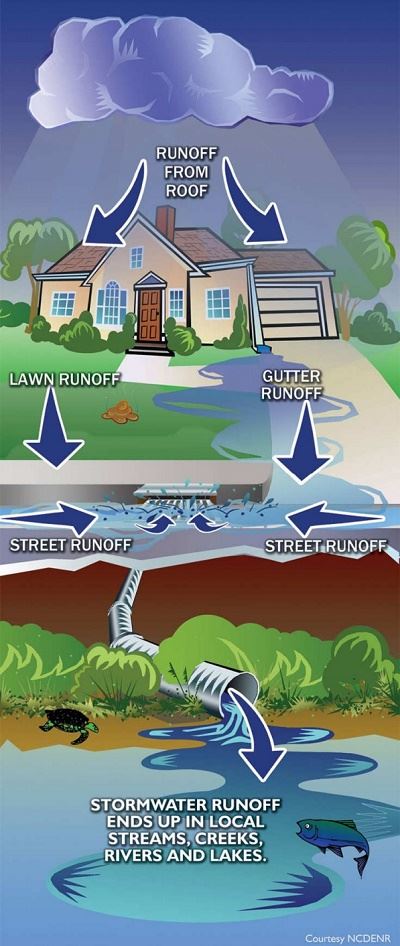
Excess irrigation and wash water contributes to pollution at local beaches. This water can carry excessive fertilizer, pesticide, herbicide, automobile fluid, paint, trash, animal waste, and other pollutants to the storm drain system that flows untreated into channels, harbors, and the ocean where it can endanger marine life and contaminate beaches.
CAUSES
- Common Household Cleaners
- Detergents From Washing Your Car
- Fertilizers
- Improper Disposal Of Paint, Oil, or Other Chemicals
- Insecticides, and Fungicides
- Loose Grass Clippings and Leaves
- Pet Droppings
- Poorly Maintained Septic Systems
- Soil From Exposed Areas in the Yard
- Weed Killer
EFFECTS
- Soil in runoff carries contaminants that smothers and kills aquatic life.
- Fertilizers, car exhaust, and detergents cause explosive plant and algae growth, which depletes water of oxygen, killing fish and animals as well as creating a terrible smell.
- Loose grass clippings and leaves also add to this and clog drainage systems.
- Pet droppings and septic tank overflows can cause diseases like dysentery, hepatitis, and parasite infections by getting into drinking water and recreation areas.
- Oil, paint, cleaning supplies, and other toxic materials from cars and batteries contaminate drinking water and kill fish, animals, and plants.
SOLUTIONS
- Adjust sprinklers to minimize water from entering the gutter. When possible, use drip irrigation. This will also reduce water usage.
- Don’t use the hose to clean walkways, driveways, or gutters. Whenever possible, use a rake or broom to clean the yard, driveway and gutters. Use leaf blowers responsibly and never blow debris into the gutter or storm drain.
- Always use trash cans to dispose trash.
- Closely follow manufacture instructions when applying fertilizer, pesticide, or herbicide. Do not apply material onto sidewalks, curbs, streets, or other non-porous surfaces.
- Pick up pet waste and place in the trash. Never wash pet waste out into the street or into the storm drain.
- Wash vehicles at car washes that have water reclamation systems.
- Promptly fix all vehicles that leak fluids.
- Place absorbent material such as cat litter on any drips to clean up spills and dispose the material in trash.
REPORT POLLUTION
To report water pollution, promptly contact the city’s Public Works Field Service Division at 714-593-4600, or the city’s water pollution prevention hotline at 714-593-4433 during normal business hours. During non business hours, please call the Police Department at 714-593-4485.
Failure to comply with water pollution regulations can result in significant penalties and cleanup cost. For additional information, call the Public Works Department at 714-593-4433
Thank you for your assistance in preventing water pollution and protecting our environment!
For many years, the trend in pest management increasingly relied on synthetic chemical pesticides. The result has been not only a tremendous increase in the use of many dangerous chemicals, but also an increase in the number of pests that are resistant to the pesticides or new organisms becoming pests. Additionally, some pesticides used for terrestrial pest management have been found in waterways causing serious problems in the aquatic environment.
INTEGRATED PROGRAM OVERVIEW
Pest control managers are moving away from their reliance on pesticides alone toward an integrated approach that combines limited pesticide use with more environmentally friendly pest control techniques. This system is known as integrated pest management (IPM) (PDF), a strategy that focuses on the long-term prevention of pests or their damage through a combination of techniques, including preventative, cultural, mechanical, environmental, biological, and chemical control tactics. The techniques are utilized simultaneously to control pest populations in the most effective manner possible.
Developing a comprehensive IPM program and approach allows us to focus on our primary efforts of pollution prevention. By monitoring and preventing pests as well as minimizing heavy pest infestations we can reduce the need for chemicals and/or multiple applications.
PURPOSE
To protect public health and the environment, the City of Fountain Valley uses an IPM program on all city property. IPM blends effective, economical, and environmentally balanced pest control methods into a single but flexible approach to manage pest populations within acceptable limits.
Those who practice IPM take the 1st step by deciding on the nature and the source of the pest problem. They can rely on a range of preventive and treatment strategies which can be cultural, physical, mechanical, or biological. Only the least-toxic chemical pesticides should be used, as a last resort.
COMPONENTS
An IPM program contains the following key components:
- Identification: Identify the pest and/or the problem.
- Monitoring and Record-keeping: Observe the plants, or site, for potential pest problems at regular intervals. Keep records of what is seen, decisions made, actions taken, and results.
- Establish Tolerance Levels: Determine when the pest problem is likely to become serious enough to require some action.
- Least-Toxic Treatments: In an IPM Program, the object of treatment is to suppress pest populations below their injury level, but not to eradicate them. Select control strategies that are easy to carry out effectively, long-lasting, and least disruptive to the environment.
EVALUATION
Inspect after treatment action has been taken. Write down what you learn. Has the treatment been effective? How can the whole process be improved to achieve the overall objectives of the program?
There is no specific containment method that must be used for wastewater collection/diversion. However, the system must be adequately designed so that the wastewater does not flow into storm drain inlet.
All mobile and existing businesses should use 1 of the following methods:
- Portable containment areas can be made from waterproof traps, heavy-duty plastic, or rubber matting equipped with berms to prevent wastewater from running into storm drain inlets or off-site. Materials that can be used for berms include sand bags or water-filled tubing. Whatever containment material is used, it must seal tightly to the ground so that no wastewater can pass under or over the berms.
- When power washing smaller pieces of equipment, containment devices to use may include portable vinyl swimming pools, plastic 55-gallon drums on casters, and flat metal or plastic containment pads.
- Depending on the volume of wastewater generated, it may be necessary to use wet-dry vacuum or a sump pump to discharge the wastewater to the landscaping or sewer.
- Stationary or more permanent containment areas can be constructed with cement. Berms and pump systems may be used to contain wastewater and divert it to a holding tank.
- Commercial wastewater collection systems are also available for power washing. These systems can range from portable wash pits to self-contained water recycling systems. A list of companies selling this type of equipment can usually be found in the telephone book under “Pressure Washing Services and Equipment."
- Storm drain inlet covers can be made of an impermeable barrier such as a heavy-duty vinyl or plastic secured in place with materials such as concrete blocks, gravel bags, or sand bags. Storm drain inlet covers may also be available though commercial vendors.
IMPORTANT NOTE
Blocking storm drain catch basin inlets in the public right-of-way is prohibited unless permitted through an encroachment permit. Wastewater should be contained on-site.
REGULATORY INFORMATION AND REPORTS
County of Orange, OC watersheds, Orange County
Storm water Program
877-89-SPILL or 877-897-7455 or visit the websiteSanta Ana Regional Water Quality Control Board
Order No. R8-2009-0030
General Construction Activity Stormwater Permit
DEVELOPMENT AND CONSTRUCTION
New development and construction projects are required to minimize impacts on receiving water quality by incorporating Best Management Practices (BMPs) specific to both the construction and post-construction phases of the project. New development and redevelopment projects are required to minimize the impacts on receiving water quality by incorporating pollution prevention measures in their project design. Projects proponents must implement Low Impact Development (LID), source control, and treatment control BMPs. The city's Local Implementation Plan, South Orange County Model Water Quality Management Plan (WQMP), South Orange County Technical Guidance Document (TGD), and the South Orange County Hydromodification Management Plan (HMP) detail the project design requirements for each type of project. The WQMP, TGD, and HMP are collectively the BMP Design Manual for the city of Fountain Valley. Construction projects of the one acre or more are also regulated under the State Construction Permit. Developers are required to submit a Notice of Intent and prepare a Storm Water Pollution Prevention Plan (SWPPP). Construction sites less than one acre are regulated by the construction component Municipal Stormwater Permit. The City’s Local Implementation Plan details requirements for each type of project. Fountain Valley city staff regularly inspect construction sites and provide stormwater BMP education and enforcement if necessary.