 What is SB 1383 Edible Food Recovery?
To reduce food waste and help address food address food insecurity, SB 1383 requires California to recover 20% of edible food that would otherwise be sent to landfills, to feed people in need. Feeding hungry people through food recovery is the best use for surplus food and a vital way for California to conserve resources and reduce waste thrown in landfills.
California send 11.2 billion pounds of food to landfills each year, some of which was still fresh enough to have been recovered to feed people in need. To reduce food waste and address food insecurity, surplus food safe for people to eat will instead go to food banks, soup kitchens, and other food recovery organizations and services to help feed Californians in need.
What is Edible Food?
Edible food is food intended for people to eat, including food not sold because if appearance, age, freshness, grade, surplus, etc. Edible food includes, but is not limited to, prepared food, packaged foods, produce. All edible food must meet the food safety requirements of the California Retail Food Code (PDF).
Information for Edible Food Generators
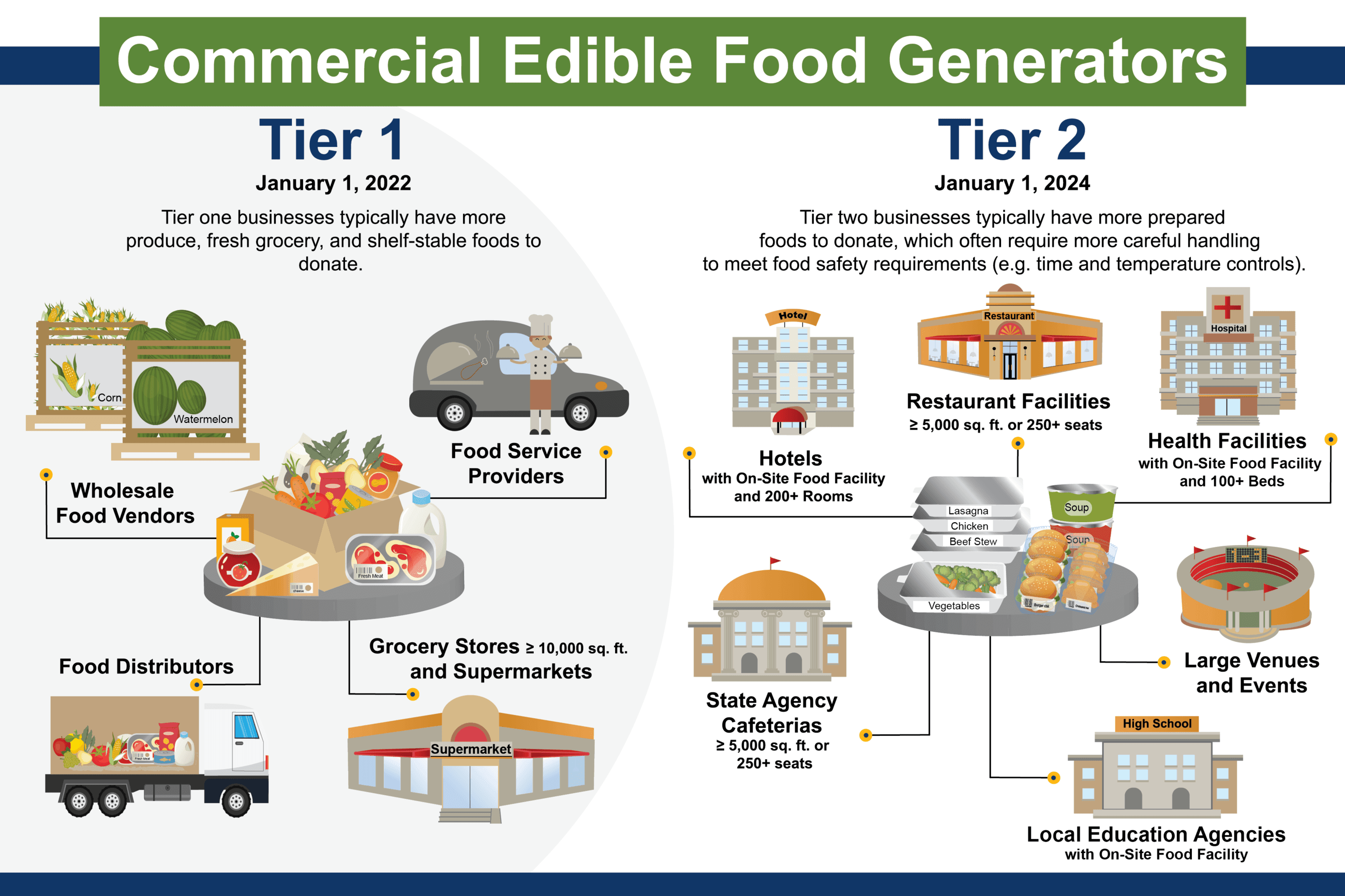
SB 1383 requires certain businesses that are defined as either a "Tier 1" or "Tier 2" edible food generator to meet the SB 1383 edible food recovery requirements. The types of businesses that fall under the Tier 1 and Tier 2 categories, and when they must become complaint, are described below.
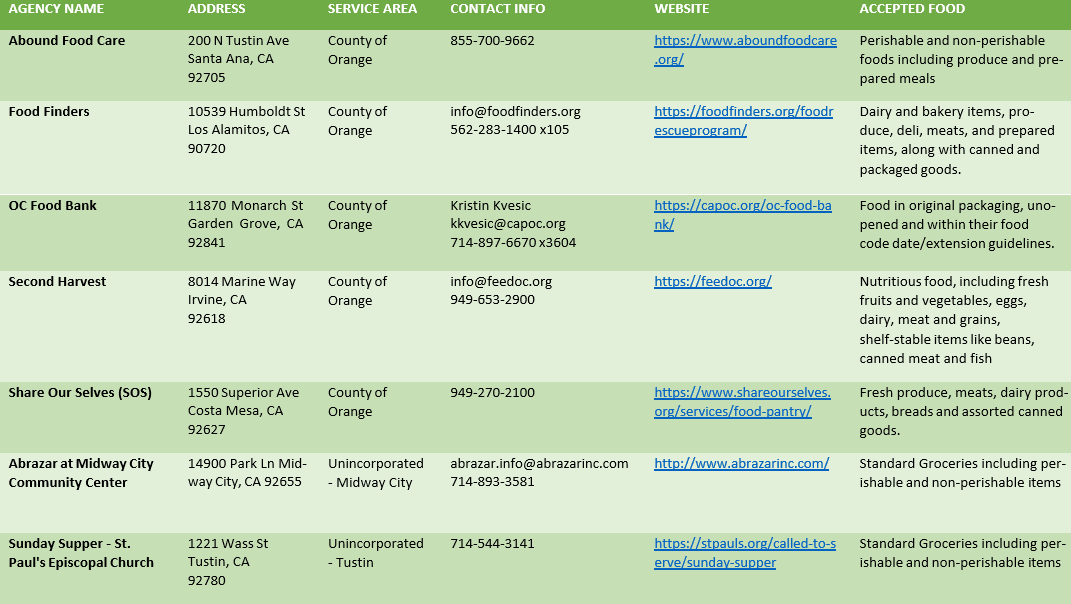
To assist Tier 1 and Tier 2 edible food generators, the City of Fountain Valley, and Republic Services have been partnered with Abound Food Care to help local businesses implement food recovery programs.
Since 2012, Abound Food Care has provided system wide solutions to help edible food generators channel excess edible food to communities rather than landfills. By reducing food insecurity and food waste, we're improving the health of our communities and the environment. Visit the website www.aboundfoodcare.org, to begin your donations to help end hunger and food waste.
Tier 1 Edible Food Generators:
These entities are required to recover the maximum amount of edible food (that would otherwise be disposed of) starting January 1, 2022.
- Grocery stores - Stores that are 10,000 square feet or more in size and primarily engaged in the retail sale of canned food, dry good, fresh fruits and vegetables, fresh meats, fish, and poultry, and any area that is not separately owned within the store where the food is prepared and served, including a bakery, deli, and meat and seafood departments.
- Supermarkets - retail store, full-line, self-service store with gross annual sales $2,000,000 or more that sell a line of dry grocery, canned goods, or nonfood items and some perishable items.
- Food Service Providers - Entities primarily engaged in providing food services to institutional, governmental, commercial, or industrial locations of others based on contractual arrangements with these types of organizations.
- Food Distributors - Companies that distribute food to entities including, but not limited to, supermarkets and grocery stores.
- Wholesale food vendors - Businesses engaged in the wholesale distribution of food, where food is received, shipped, stored, or prepared for distribution to a retailer, warehouse, distributor, or other destination.
Tier 2 Edible Food Generators:
These entities are required to recover the maximum amount of edible food (that would otherwise be disposed of) starting January 1, 2024.
- Restaurants with 250 or more seats, or a total facility size equal to or greater than 5,000 square feet.
- Hotels with an on-site food facility and 200 or more rooms.
- Health Facilities with an on-site food facility and 100 or more beds.
- Large Venues - Permanent venue facilities that annually seat or serve an average of more than 2,000 individuals within the grounds of the facility per day of operation of the venue facility. A venue facility includes, but is not limited to, a public, nonprofit, or privately owned or operated stadium, amphitheater, arena, hall, amusement park, conference or civic center, zoo, aquarium, airport, racetrack, horse track, performing arts center, fairground, museum, theater, or other public attraction facility. A site under common ownership or control that includes more than one large venue that is contiguous with other large venues in the site, is a single large venue.
- Large Events - Events, including, but not limited to, a sporting event or a flea market, that charge an admission price, or are operated by a local agency, and serve an average of more than 2,000 individuals per day of operation of the event, at a location that includes, but is not limited to, a public, nonprofit, or privately owned park, parking lot, golf course, street system, or other open space when being used for an event.
- State agencies with a cafeteria with 250 or more seats or total cafeteria facility size equal to or greater than 5,000 square feet
- Local education agencies with an on-site food facility.
Senate Bill 1383 requires Tier 1 and Tier 2 Edible Food Generators to do the Following:
Recover excess edible food - SB 1383 does not require all excess edible food to be donated. It does however, state the following for Tier 1 and Tier 2 edible food generators:
- Tier 1 and Tier 2 edible food generators shall not intentionally spoil edible food that is capable of being recovered by a food recovery organization or service.
- Edible food generators are allowed to give away excess food to employees, take it home for personal use, give it away to customers, etc.
- Edible food generators must recover (for human consumption) the maximum amount of edible food that would otherwise be disposed of. This can be accomplished by donating or paying for the food to be recovered by a food recovery organization or service, which includes, but is not limited to food banks, food pantries, soup kitchens, for-profit food recovery services and other non-profits that distribute food to people in need.
A large venue or large event operator that does not provide food services, but allows for food to be provided, shall require food facilities operating at the large venue or large event to comply with the SB 1383 edible food recovery requirements
Establish Contracts or Written Agreements:
Tier 1 and Tier 2 generators must establish contracts or written agreements with food recovery organizations and services. Food recovery organizations and services vary in the amount and types of food they can receive, so edible food generators may need to establish contracts or written agreements with multiple food recovery organizations and services to be in compliance. CalRecycle has developed a Model Food Recovery Agreement that can be used as an example. These contracts can include the establishment of a regular edible food delivery or collection schedule, identifying allowable edible foods for recovery, and cost-sharing options.
Maintain Recordkeeping:
Tier 1 and Tier 2 edible food generators must generators must maintain records of their food recovery activities. This recordkeeping includes the following:
- A list of each food recovery service or organization that collects or receives its edible food under a contract or written agreement
- A copy of contracts or written agreements between the edible food generator and a food recovery service or organization
- For each food recovery organization or service that Tier 1 and Tier 2 edible food generators has a contract or written agreement with, records must be kept.
- The name, address and contract information of the service or organization
- The types of food that will be collected by or self-hauled to the service organiztion
- The established frequency that food will be collected or self-hauled
- The quantity of food collected or self-hauled to a service or organization for food recovery. The quantity shall be measured in pounds recovered per month
Jurisdictions are required to monitor compliance by performing annual inspections to review the following records:
- Contract or written agreement information for food recovery organization and services
- Schedules for food recovery deliveries or collections
- Quantity of food recovered in pounds per month
- Types of food each recovery organization will receive or collect
More information for Tier 1 and Tier 2 edible food generators is available on CalRecycle's website: https://calrecycle.ca.gov/organics/slcp/foodrecovery/donors/
The EPA created a list of ideas and activities that grocery stores and other food generators can implement to prevent food waste. Explore ways to mitigate food waste here.
Information for Food Recovery Organizations and Foo d Recovery Services
SB 1383 requires Tier 1 and Tier 2 edible food generators to recover (for human consumption) the maximum amount of their edible food that would otherwise be disposed, but it does not require food recovery organizations and services to participate. Each food recovery organization and service can decide if they would like to work with edible food generators and what, if any, food they will take.
Food Recovery organizations:
An entity that engages in the collection or receipt of edible food from commercial edible food generators and distributes that edible food to the public for food recovery either directly or through other entities including, but not limited to, a food bank, a non-profit charitable organization, or a non-profit charitable temporary food facility.
Food Recovery Service:
A person or entity that collects and transports edible food from a commercial edible food generator to a food recovery organization or other entities for food recovery.
If a food recovery organization or service does decide to participate in SB 1383 by working with a Tier 1 or Tier 2 edible food generator, they will need to do the following:
Contracts or Written Agreements:
Tier 1 and Tier 2 edible food generators are required to have written agreements or contracts with food recovery organizations or services. CalRecycle has developed a Model Food Recovery Agreement that can be used as an example. The contracts or written agreements can include:
- Establishing a regular food recovery delivery or collection schedule
- Identifying allowable foods for recovery
- Cost-sharing options (food recovery organizations and service do not need to accept recovered food for free, they can decide to charge for their collection/recovery services)
Recordkeeping:
Food recovery organizations or services that have a contract or written agreement to collect or receive edible food directly from Tier 1 or Tier 2 edible food generators are required to keep records.
Recordkeeping Requirements for Food Recovery Organization:
- The name, address, and contact information for each Tier 1 or Tier 2 edible food generator that the service collects edible food
- The quantity in pounds of edible food collected from each Tier 1 or Tier 2 edible food generator per month
- The quantity in pounds of edible food transported to each food recovery organization per month
- The name, address, and contact information for each food recovery organization that the service transports edible food to for food recovery
Reporting:
Food recovery organizations and services must report the total pounds recovered from Tier 1 and Tier 2 edible food generators in the previous calendar year to the jurisdiction where their primary address is physically located. The jurisdiction will in turn report to CalRecycle the pounds collected to measure statewide progress towards achieving 20% edible food recovery goal.
How can businesses be protected from liability?
The "Bill Emerson Good Samaritan Food Donation Act" (Public Law 104-210) makes it easier for businesses to donate to food recovery organizations and services by protecting donors from liability when donating to non-profit organizations. The act protects donors from civil and criminal liability should the product donated in good faith cause harm to the needy recipient.
Resources Available: